A Visual Exploration of Two Museum Collections
Two Berlin museum collections in one shared space, arranged by visual and textual similarity so that resonances emerge across catalog boundaries.
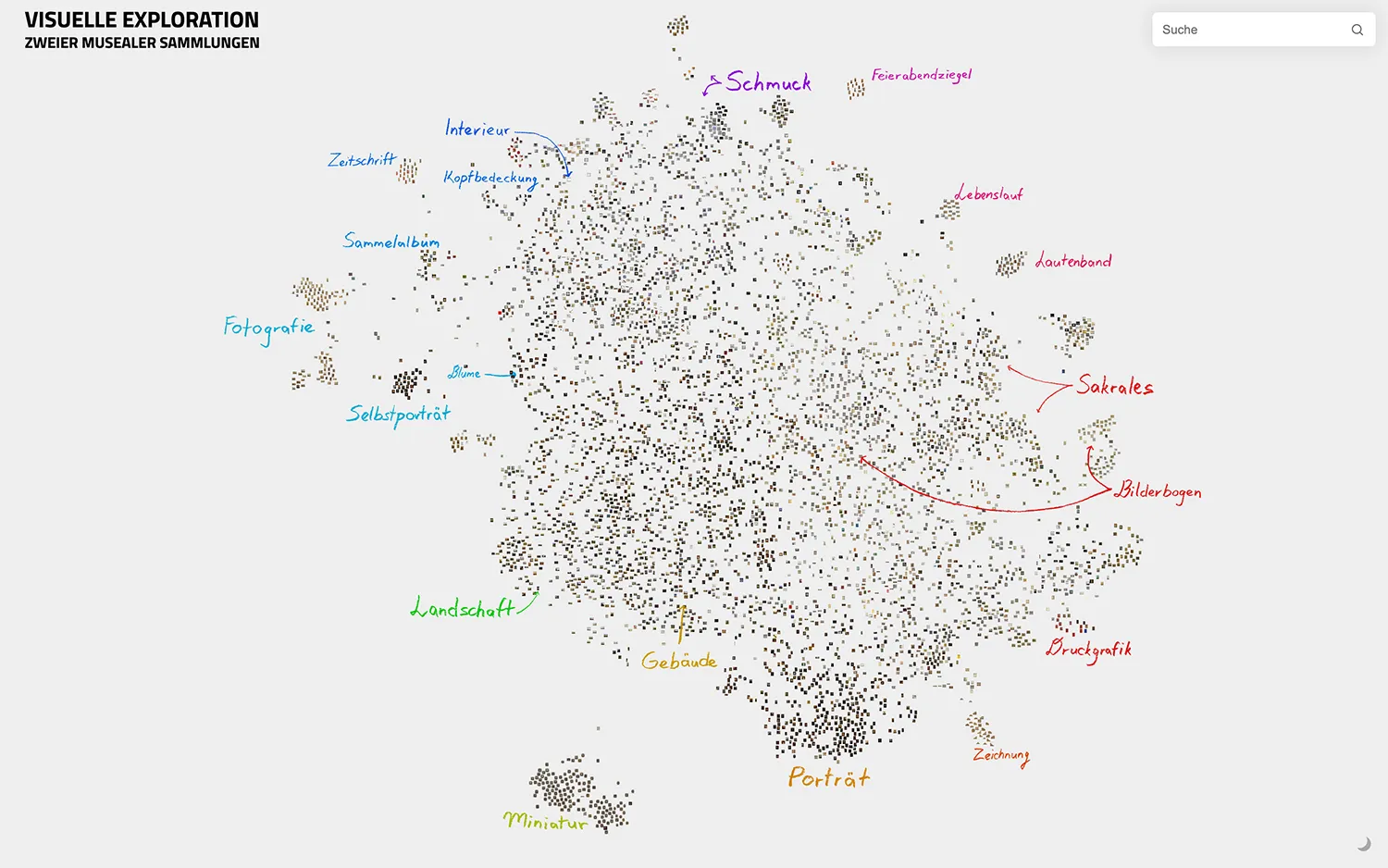
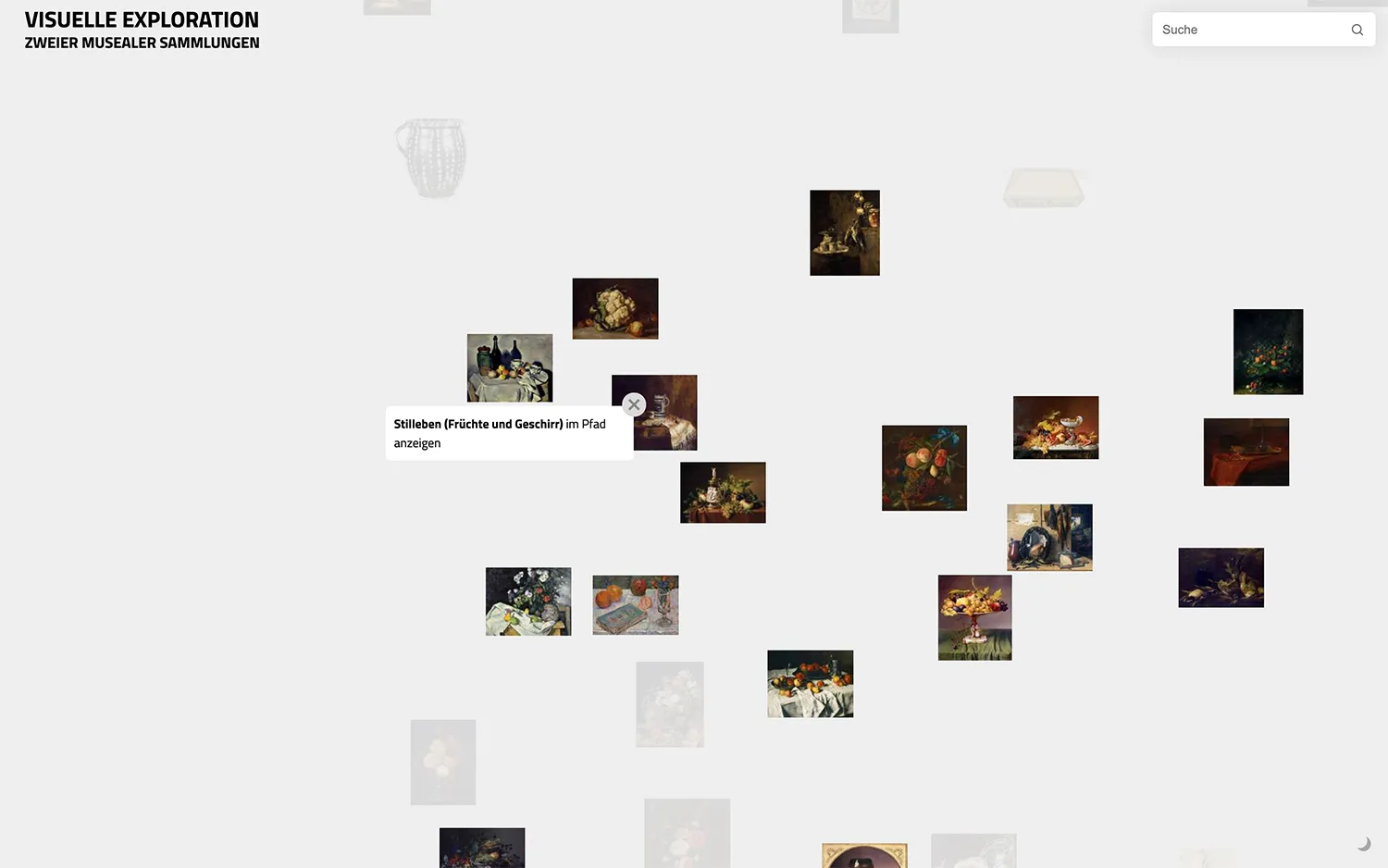
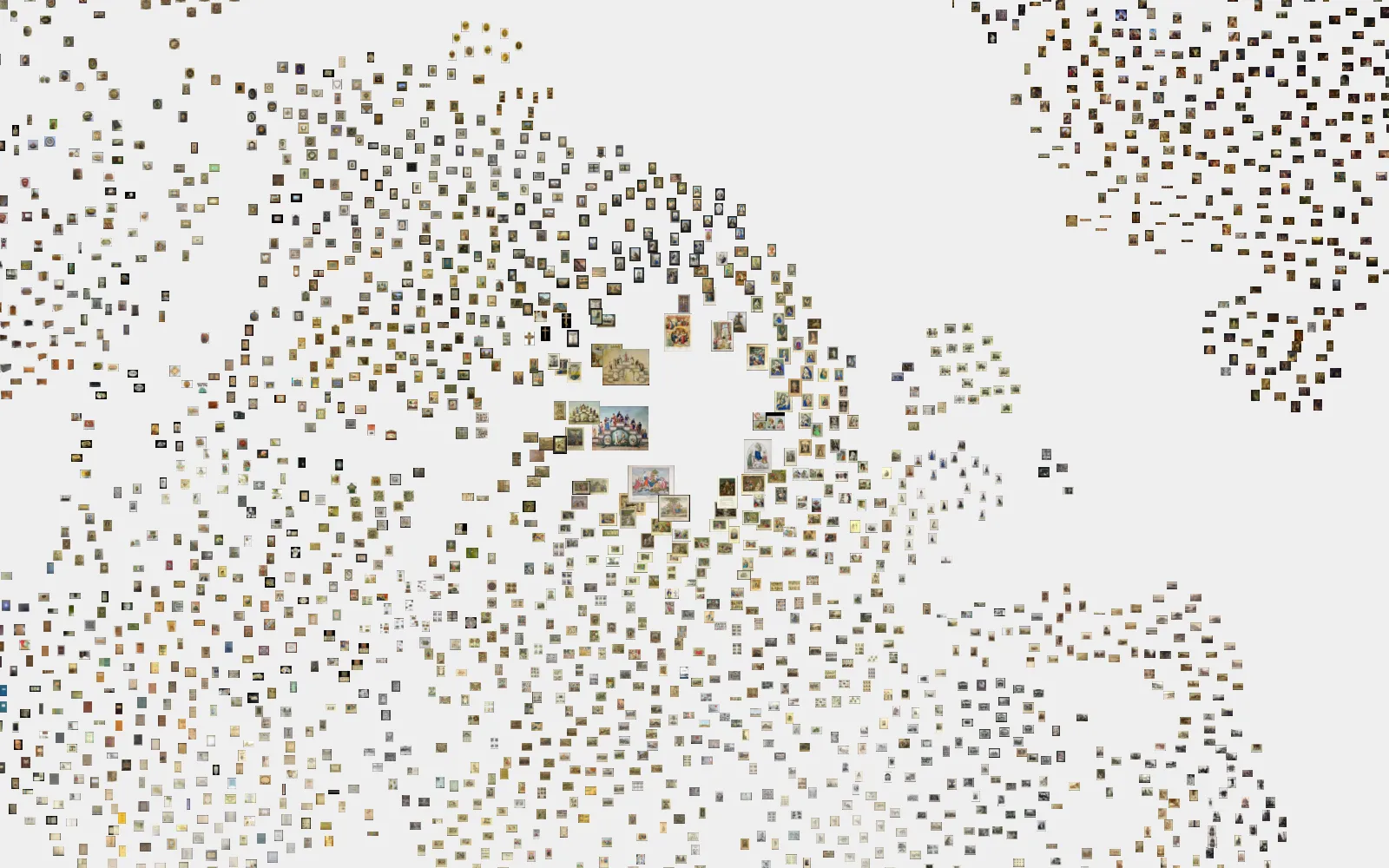
A museum that stops sorting and starts associating: this interface places two collections of the Berlin State Museums (SMB/SPK) — 5,140 nineteenth-century objects from the Alte Nationalgalerie and the Museum of European Cultures, fine art paintings next to everyday artifacts — in one shared space, arranged not by catalog logic but by similarity, so that resonances across collection boundaries become visible.
The ambition was to move away from object-centeredness: instead of treating a collection as a list of records to query, the interface offers evocative arrangements that invite associative, curiosity-driven exploration — and a more honest picture of the breadth of the holdings than any search result could give.
Under the hood, every object is encoded twice: Google’s BiT-M model extracts a feature vector from the image, and the Multilingual Universal Sentence Encoder one from the title. Concatenated, they form an imprint of how an object looks and what it is about; UMAP reduces these vectors to two dimensions to position every object on the canvas.

A test in the feature-extraction notebook: a Pietà group from the Museum of European Cultures and its five nearest neighbors by image features, two of them paintings from the Alte Nationalgalerie. Object photos: Staatliche Museen zu Berlin (Jörg P. Anders, Andres Kilger, Ute Franz-Scarciglia and unknown photographers), CC BY-NC-SA 4.0.
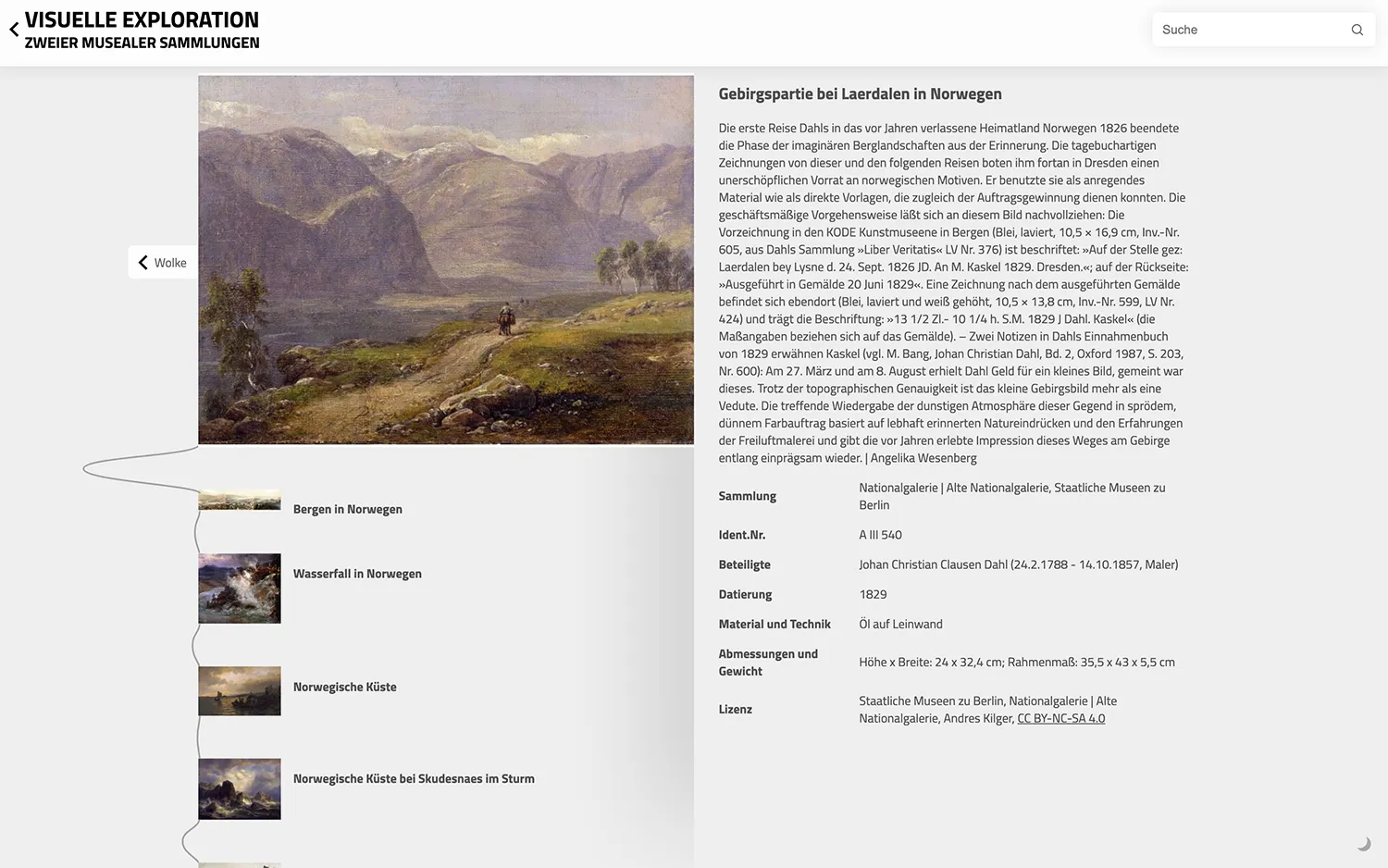
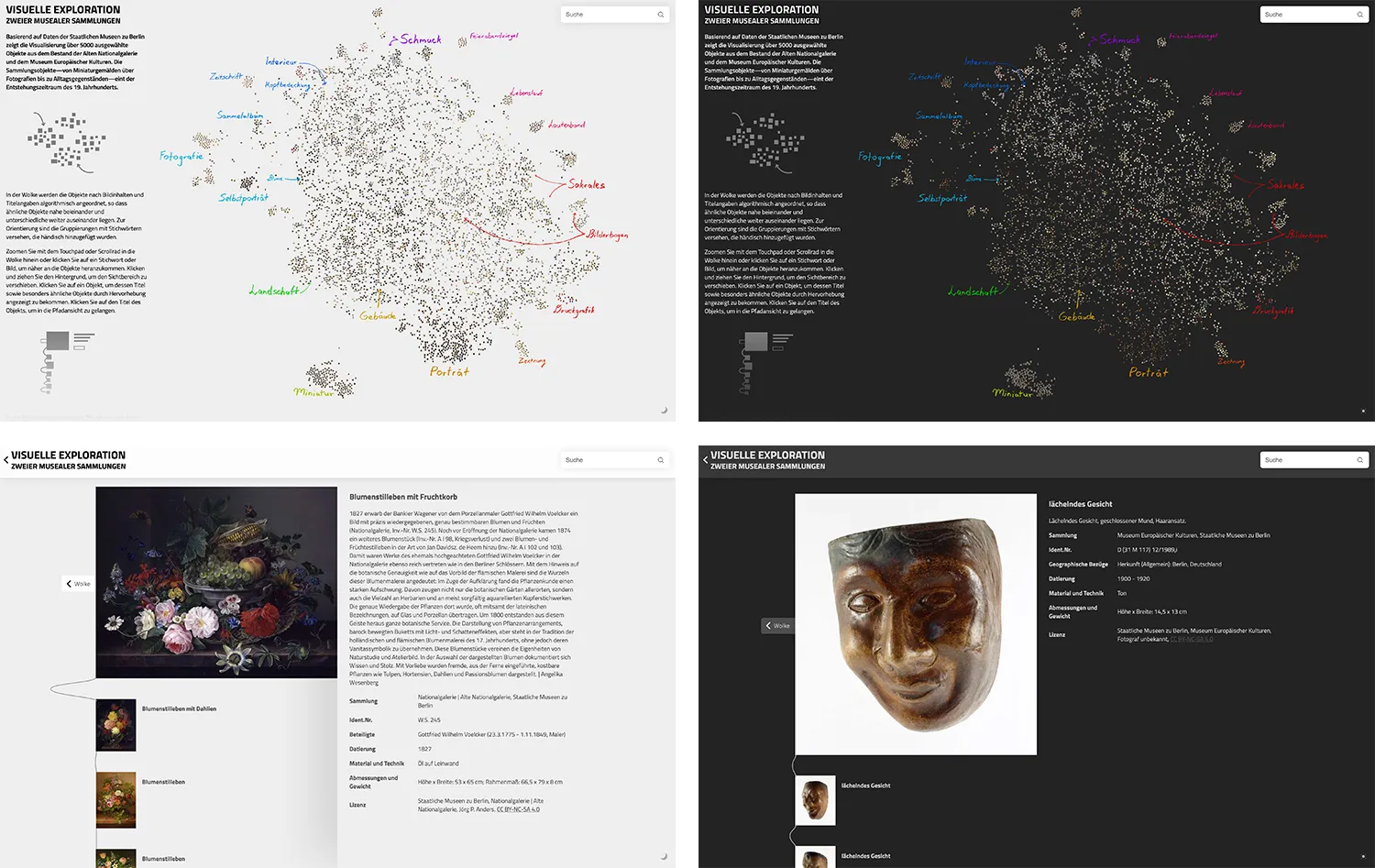
Hand-drawn keywords — inspired by Moritz Stefaner’s Multiplicity and developed closely with collection experts — float over the machine-generated arrangement to support orientation. Selecting an object opens the path view: details and context on one side, and a trail of the most similar objects by image and title on the other, ready to be followed across both collections. The thread that runs down the trail swings out wider as the objects grow less similar to the one selected.
The visualization is built with Svelte, D3, and PixiJS, continuing the lineage of Past Visions and VIKUS Viewer; early feasibility prototypes ran as Observable notebooks, and everything, down to the four Jupyter notebooks of the feature pipeline, is published as open source; the museum also hosts the interface at visualisierung.smb.museum.
Developed with Mark-Jan Bludau, Viktoria Brüggemann, and Marian Dörk at the UCLAB, in a research cooperation with the Berlin State Museums within museum4punkt0, funded by the Federal Government Commissioner for Culture and the Media.
Images
Images: Object images: Staatliche Museen zu Berlin, CC BY-NC-SA 4.0
Left and right arrow keys flip through the pile, Enter enlarges the top image.