Christopher Pietsch
is an artist and creative technologist working across data visualization, generative AI, and physical computing. He builds installations and interfaces that turn abstract technical systems into things you can touch, steer, and play with.
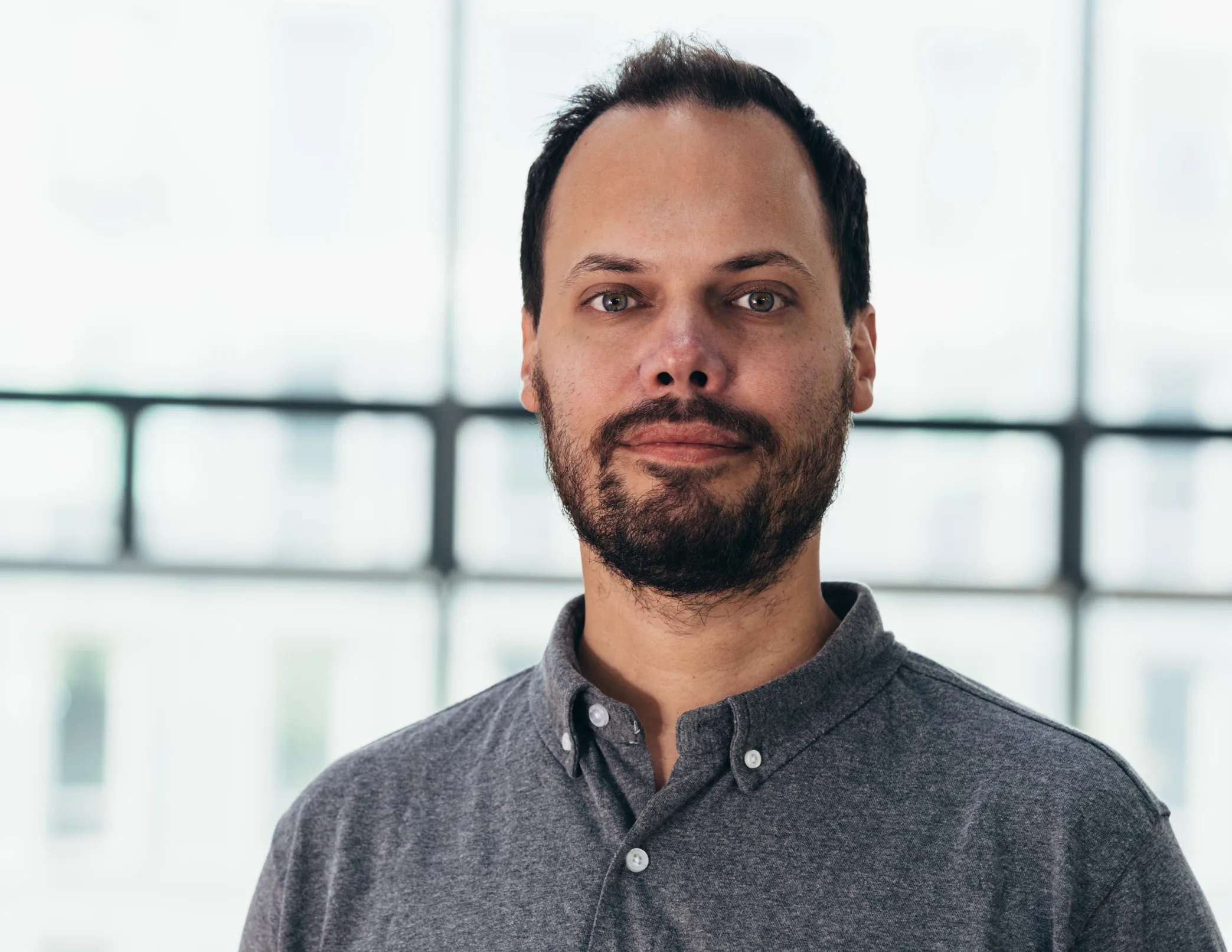
Photo: Jonas Parnow
His recent work brings AI out of the browser and into physical space. With projects like Transferscope (a handheld AI camera) and unStable Mirror, he turns generative models into instruments you can point at the world and improvise with. Because he builds the whole stack himself, from LoRA training and local inference to custom hardware and interfaces, he shapes the underlying pipeline right alongside the physical object.
Shown at IPAI Living Room · Hidden Layers · Mensch und Computer · KIKK Festival · IEEE VISAP All exhibitions →
Alongside his installations, he designs large-scale data visualizations and open-source software, including VIKUS Viewer, an interface that lets people visually wander through massive cultural collections.
He works independently and with academic research labs, most recently at the AI+D Lab at HfG Schwäbisch Gmünd and previously at the Urban Complexity Lab at FH Potsdam. Christopher holds a degree in Interface Design from FH Potsdam, where his early work experimented with brain-computer interfaces (Brain State Sharing, Beyond Perception).
Themes
Across very different subjects (cultural memory, machine vision, neural signals, urban movement), the work keeps returning to the same handful of concerns.
-
Embodied interfaces
Screen-based systems become physical, spatial, and bodily experiences.
-
Exploration over search
Large collections become places to wander, zoom, compare, and form associations.
-
Human-scale complexity
Overwhelming systems are translated into views that stay approachable without flattening them.
-
Questioning the systems
Interfaces reveal the assumptions, biases, infrastructures, and politics inside technical systems.
-
Playful seriousness
Critical subjects become accessible through poetic, tactile, and often surprising interactions.
Materials & tools
AI pipelines
Visualization
Interface & physical
Research contexts
Contact
For exhibitions, commissions, research collaborations, or questions about the work: