Brain State Sharing
An experimental installation that broadcasts live EEG data as light, sound, and shared sensory experience.
Is it possible to transfer someone’s mental state to another person through technology? Brain State Sharing is an experimental installation that tried exactly that: broadcasting the live EEG signals of a meditating person to volunteers — as flickering light and binaural sound.
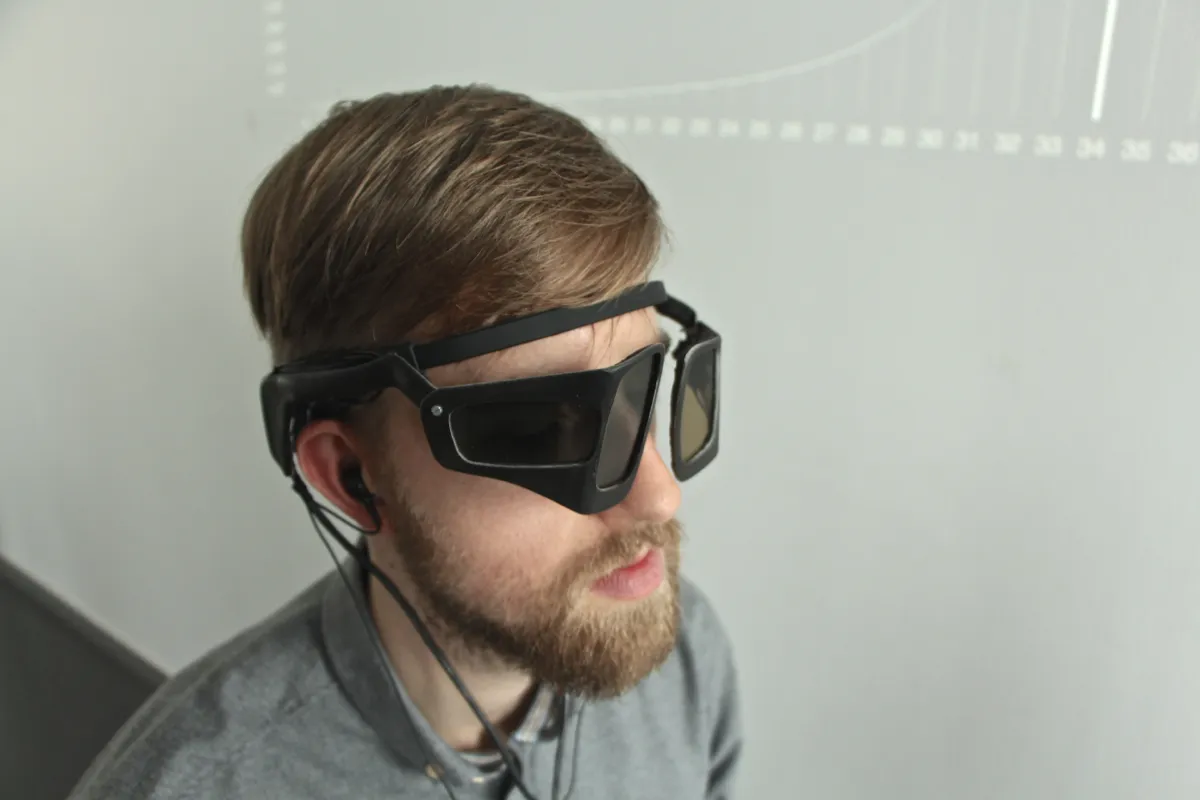
The project grew out of the course “Messing with our Minds” (Willy Sengewald, FH Potsdam, with neuroscientist Matti Gärtner), run in collaboration with the Languages of Emotion cluster at FU Berlin and built around a rare resource: real-time brain activity, streamed from an EEG recording device through MATLAB into Processing. Researching what one could do with a live feed of someone’s brain, we found brain machines — glasses with LEDs and headphones that pulse light and sound at fixed frequencies (16, 10, and 7 Hz) to nudge the brain toward relaxed, meditative states. The sound is binaural: the frequency difference between the left and right channel matches the target rhythm.
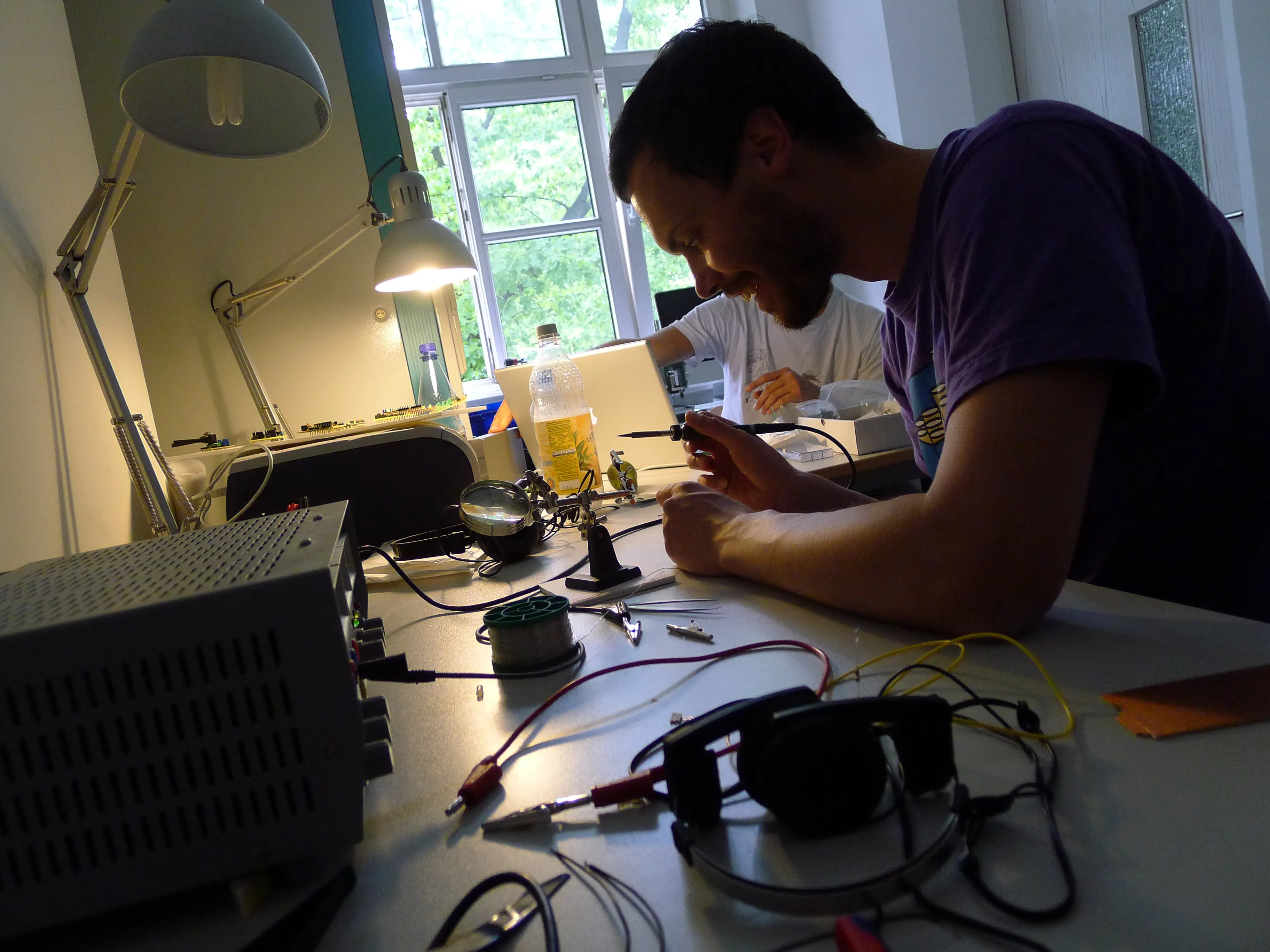
We first built an Arduino-driven brain machine ourselves — three LEDs on each side of a headphone bow — and ran self-experiments to see whether the effect was real. It was, more for some than for others, but reliably enough to design an experiment around it.
That raised the actual question of the project: if stimulation can shape a brain state, can the measured state of one brain be passed on to others?
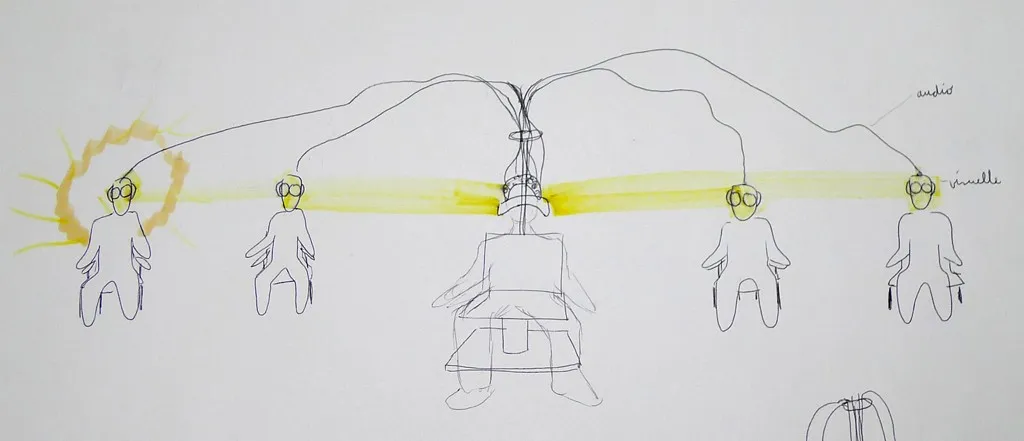
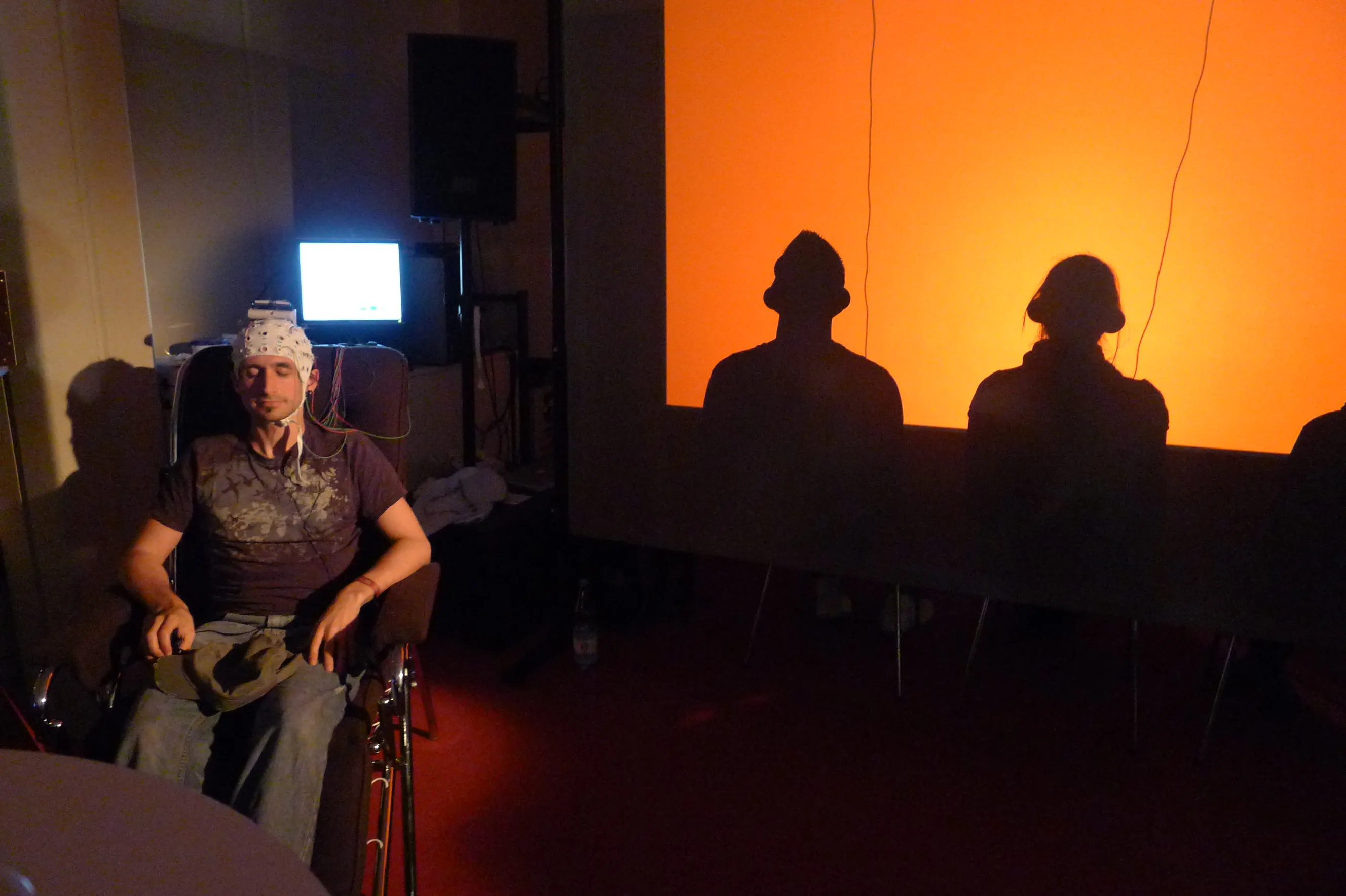
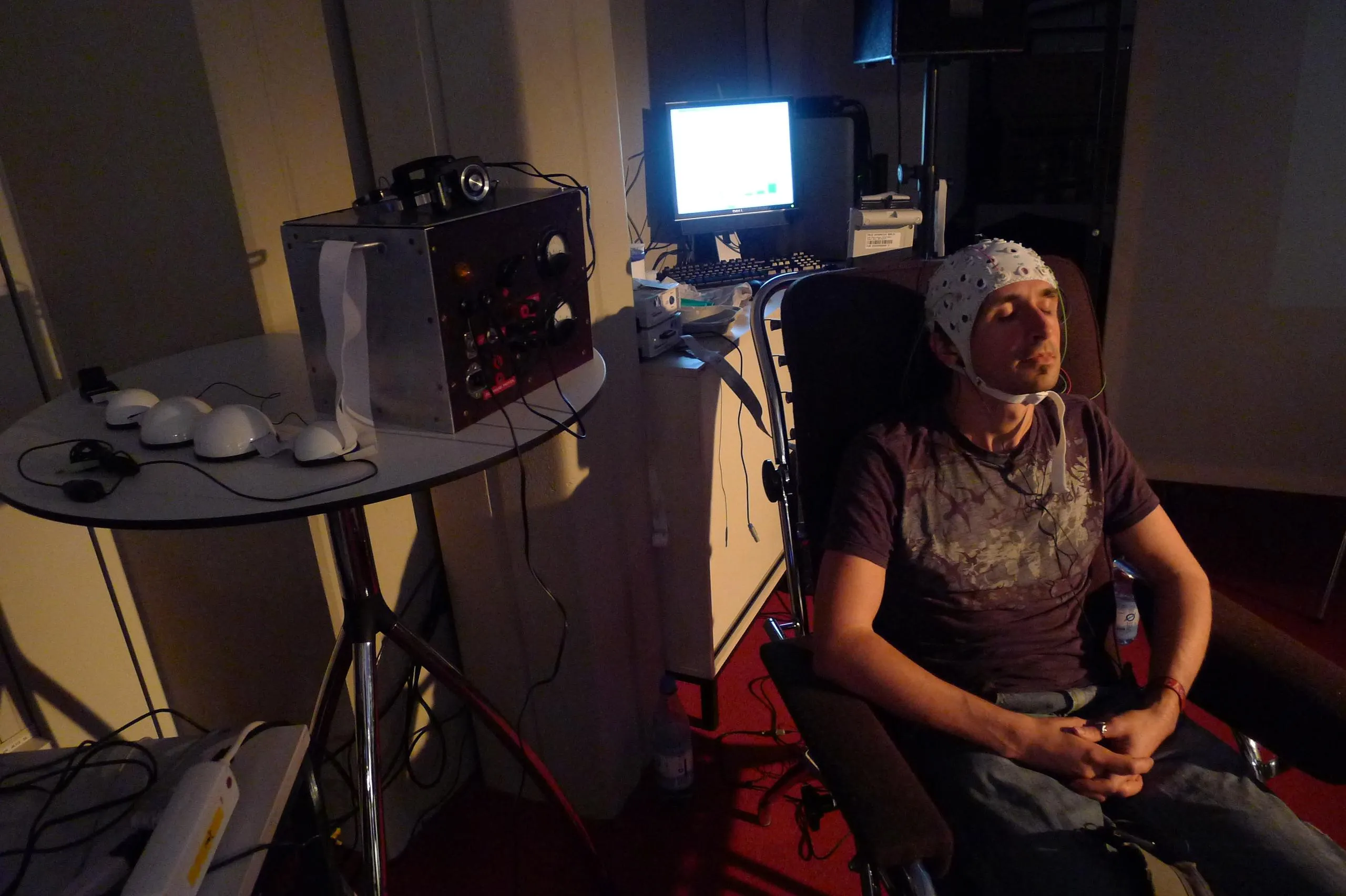
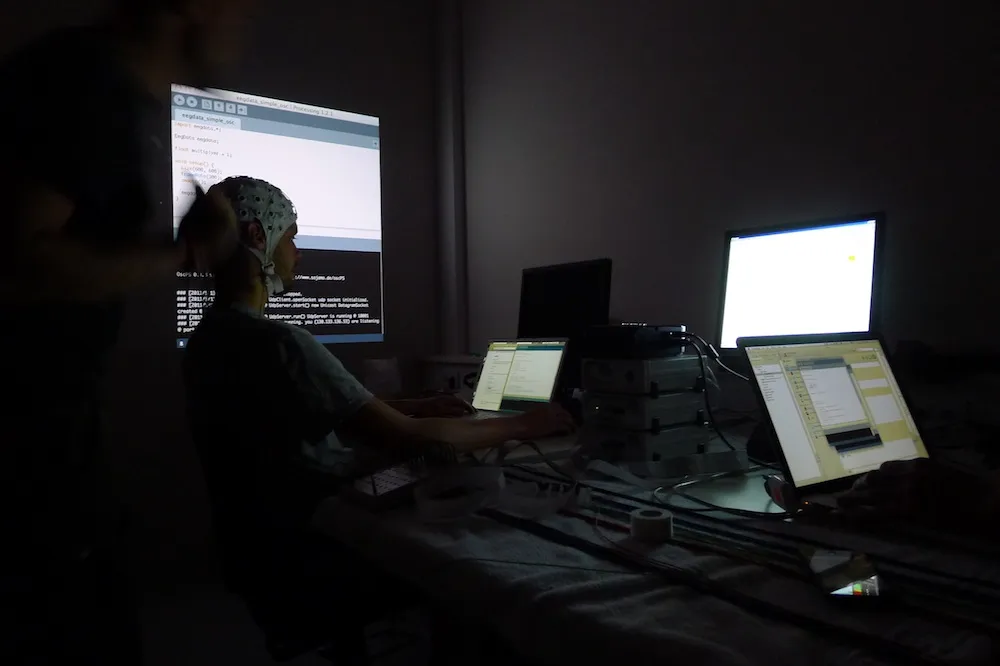
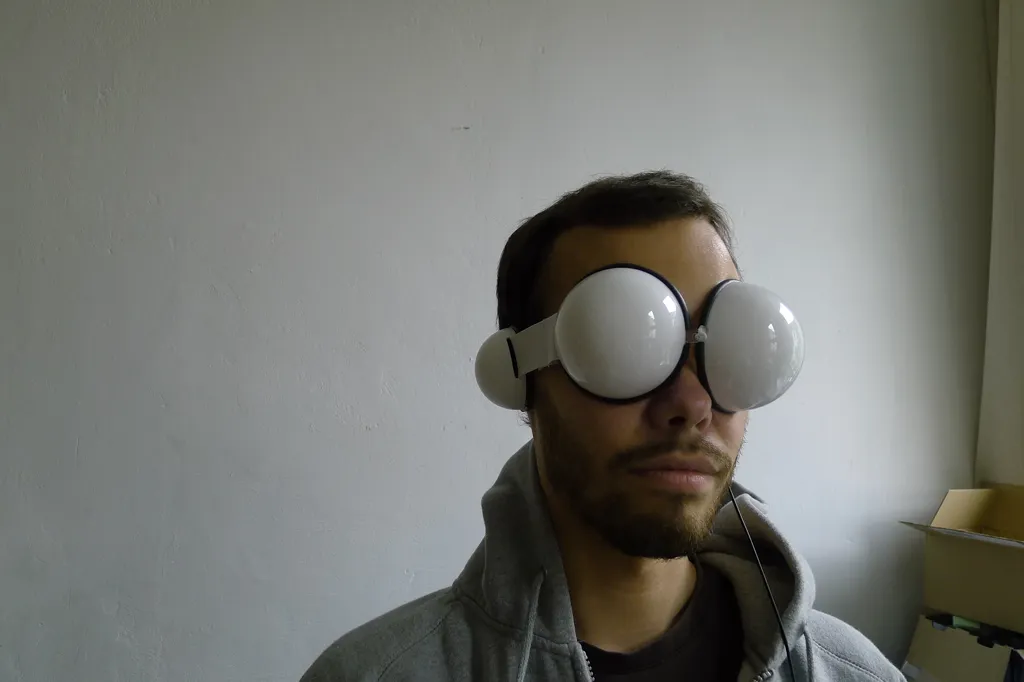
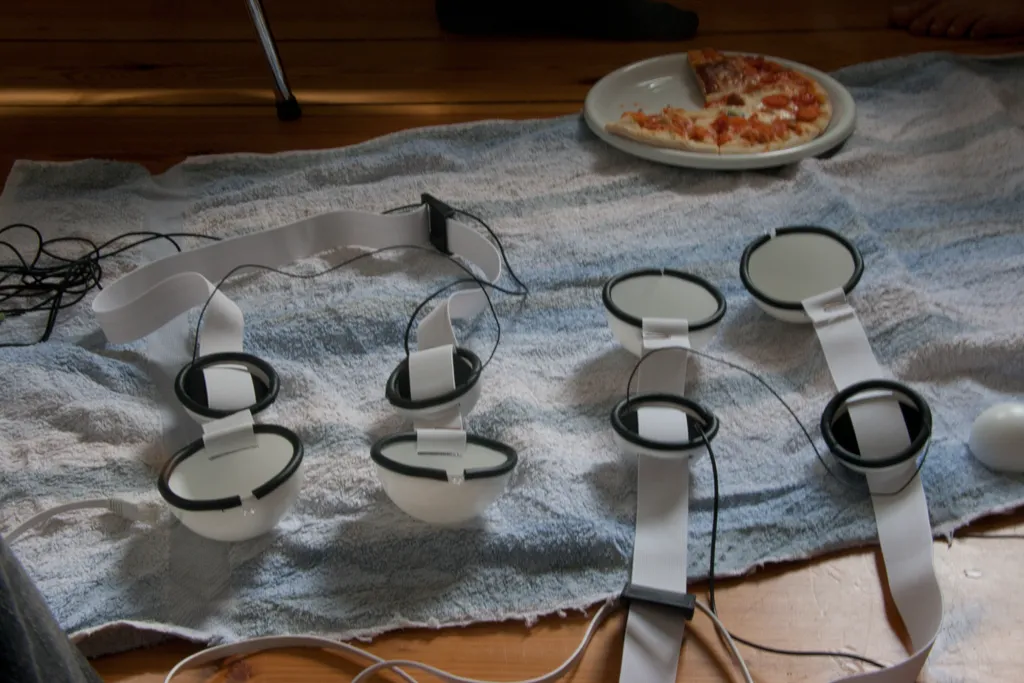
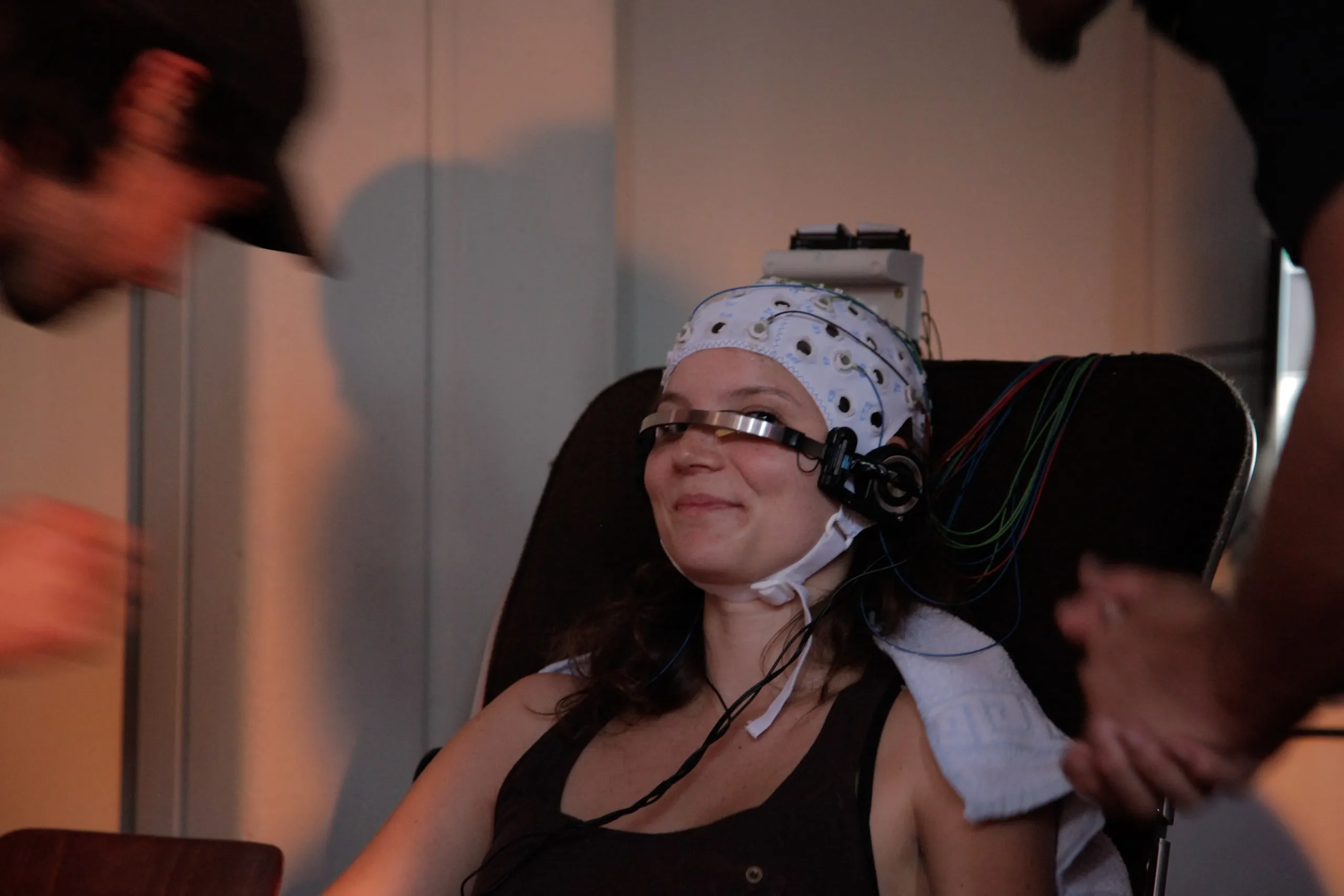
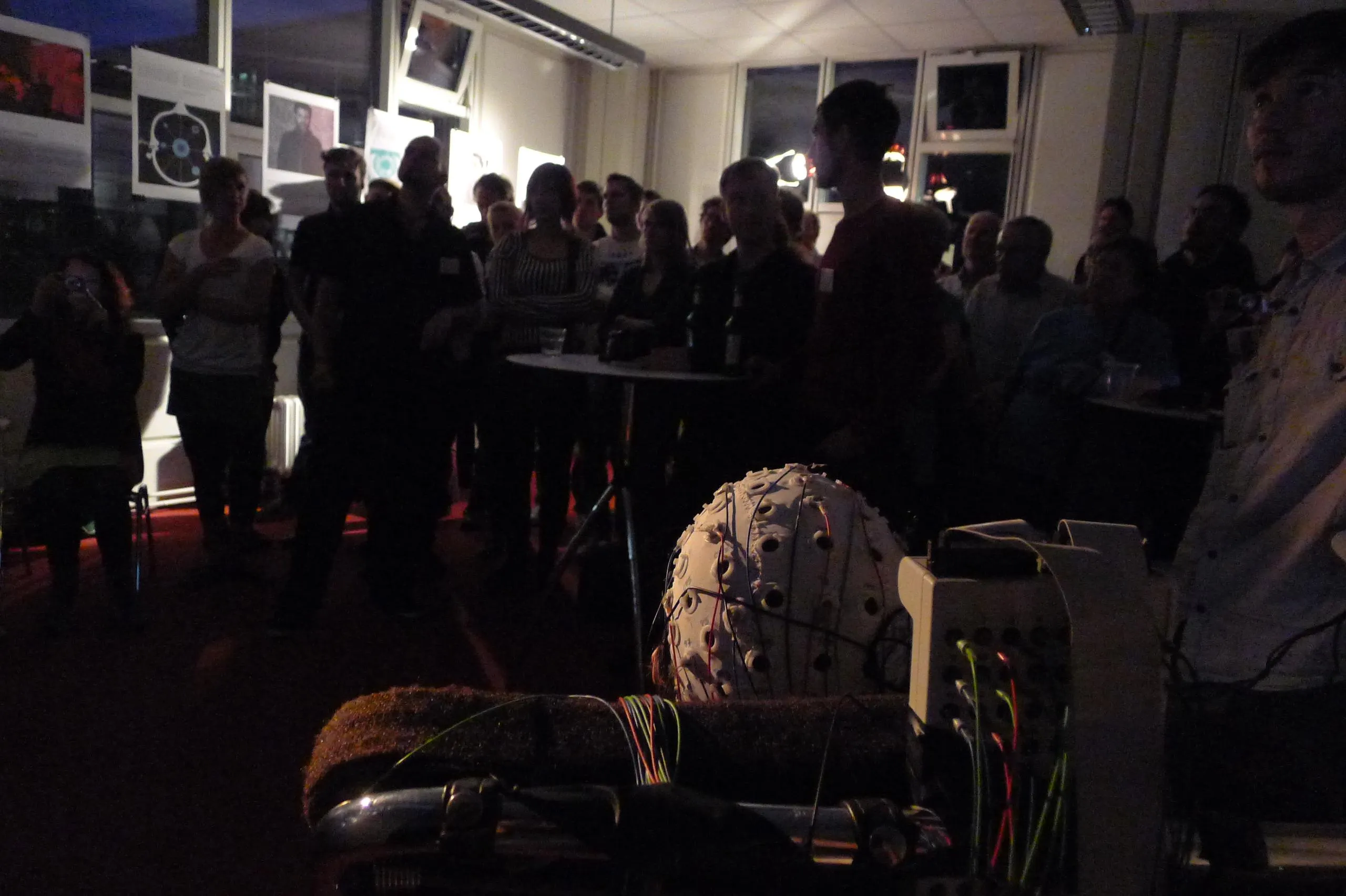
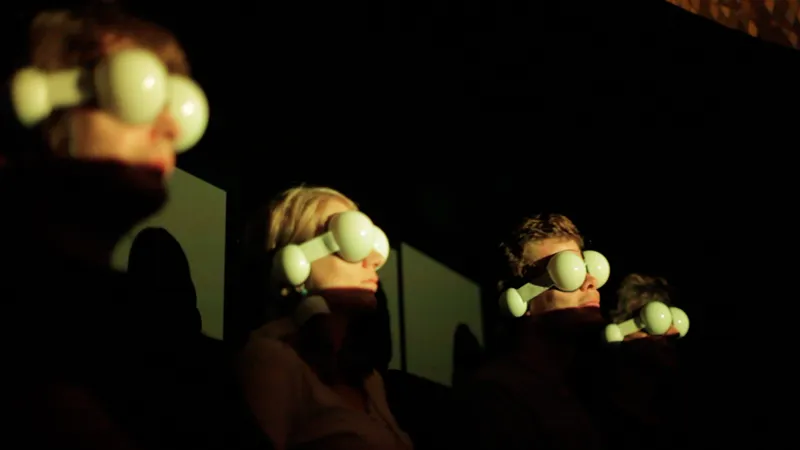
At the Lange Nacht der Wissenschaften at FU Berlin, the setup scaled up. One person meditated, wired to a 19-electrode EEG. Instead of building many wearable brain machines, we built one big one: a projector flashed the visual signal onto a large screen while the audio played through headphones. Three volunteers at a time sat on the back side of the screen, directly in the projector’s light, wearing diffuser masks we made from transparent spheres with embedded headphone shells.
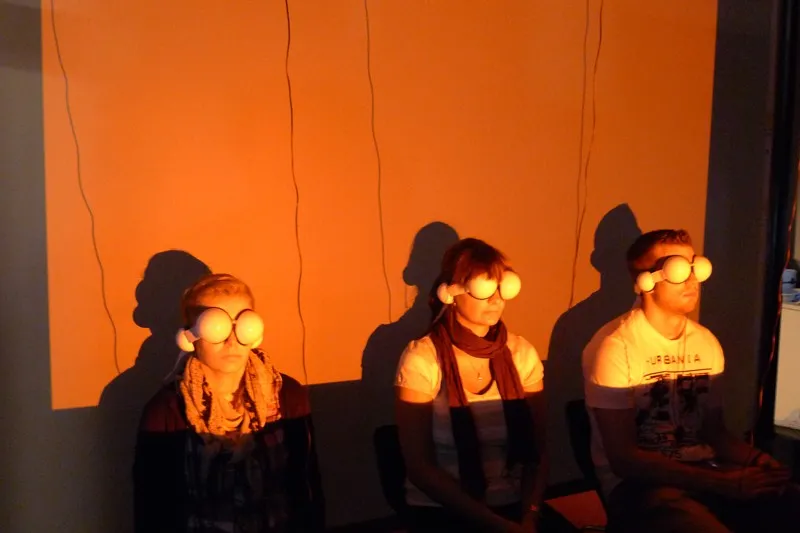
The audience saw only their silhouettes and dangling cables in the flickering light. In the afternoon, visitors could try our first brain machine; its Arduino sat in a box that doubled as a fake control panel, where we pretended to dial in the frequencies. Some kept it on for twenty minutes, others gave up within one. During the broadcast itself, one volunteer fell asleep while the subject meditated.
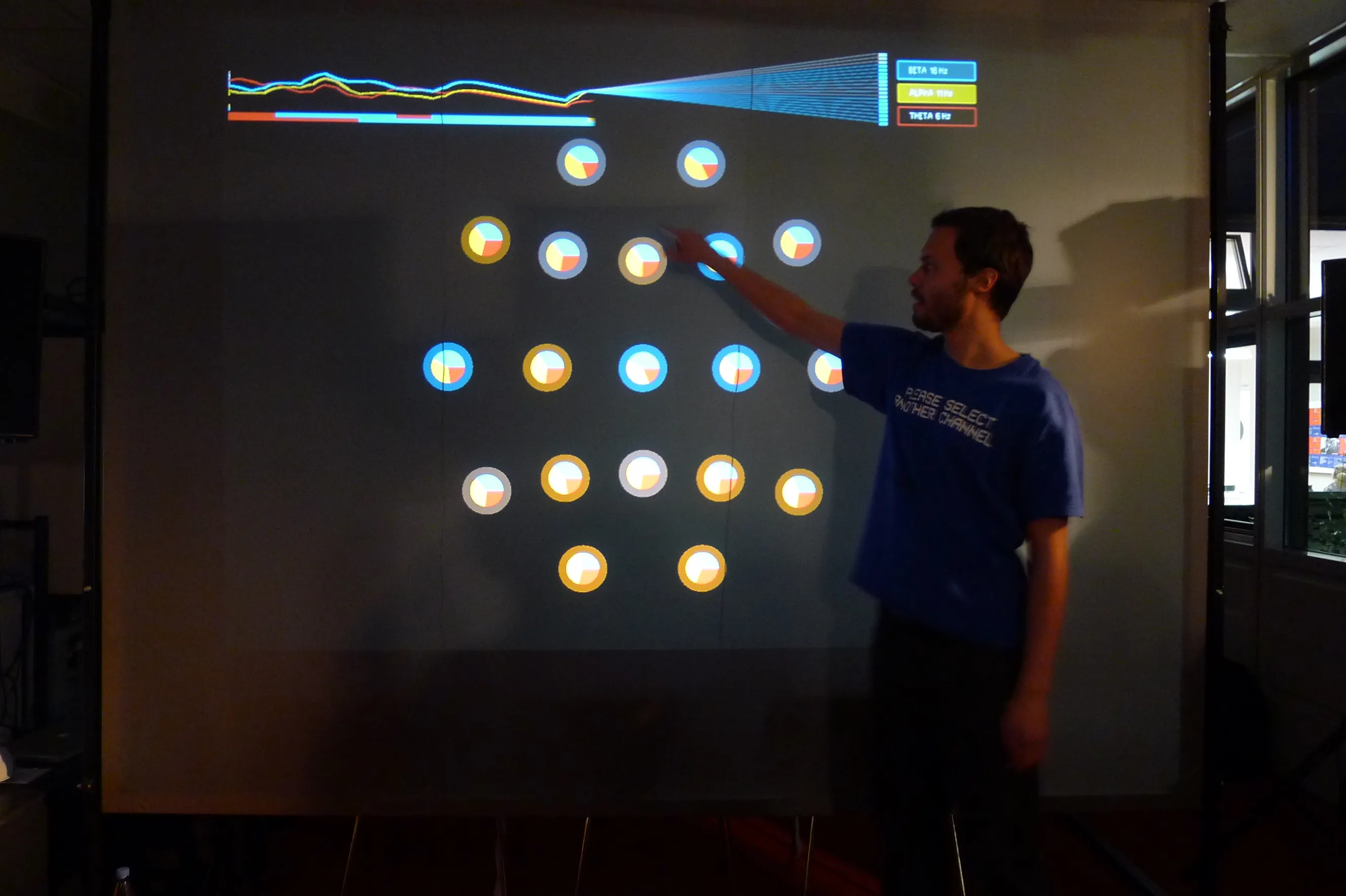
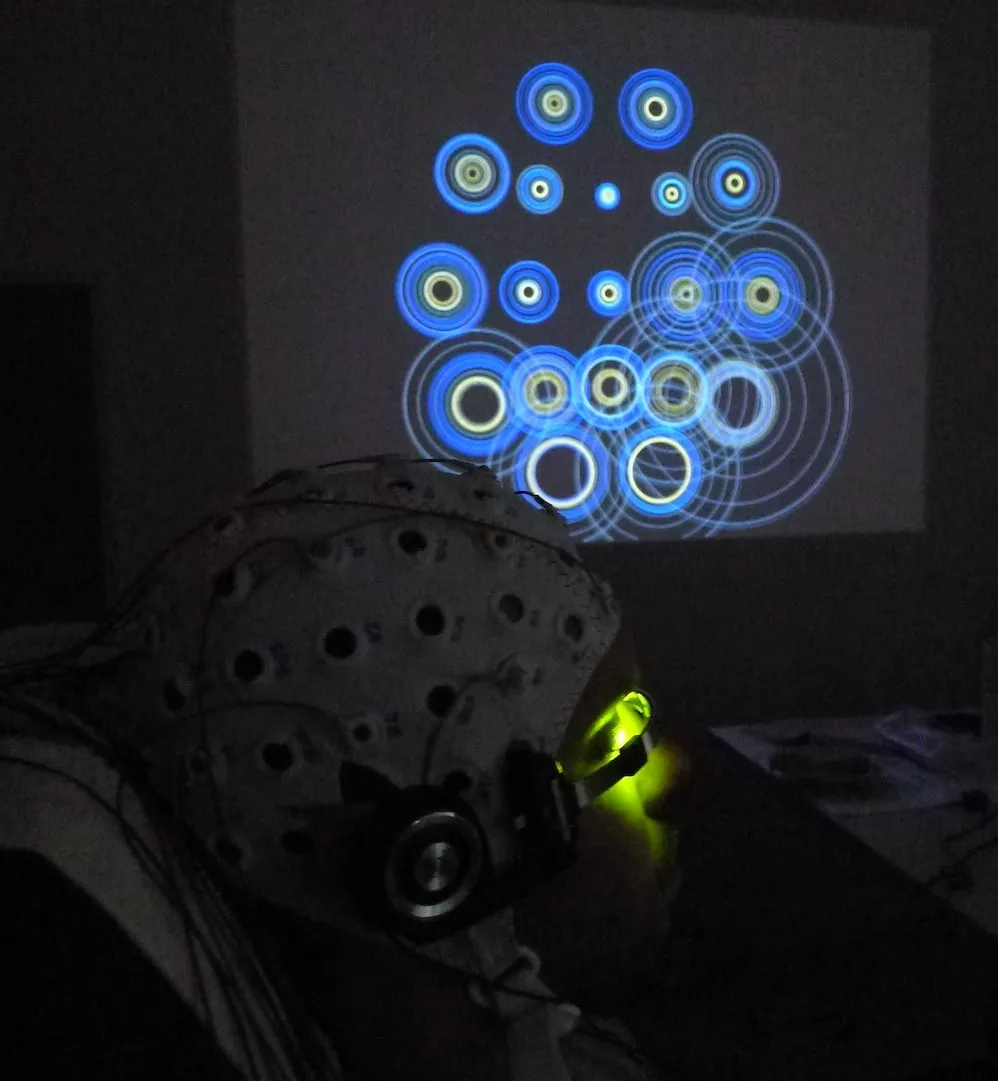
A live visualization tracked the experiment: the 19 electrodes were laid out as on the head, each shown as a ring-and-pie chart of its dominant frequency band, with a running timeline of peaks and averages along the top — the data through which we watched meditation and machine influence each other. The setup also produced accidental biofeedback loops: while debugging the visualization wired to the EEG myself, I could watch my own brain react to seeing its own data.
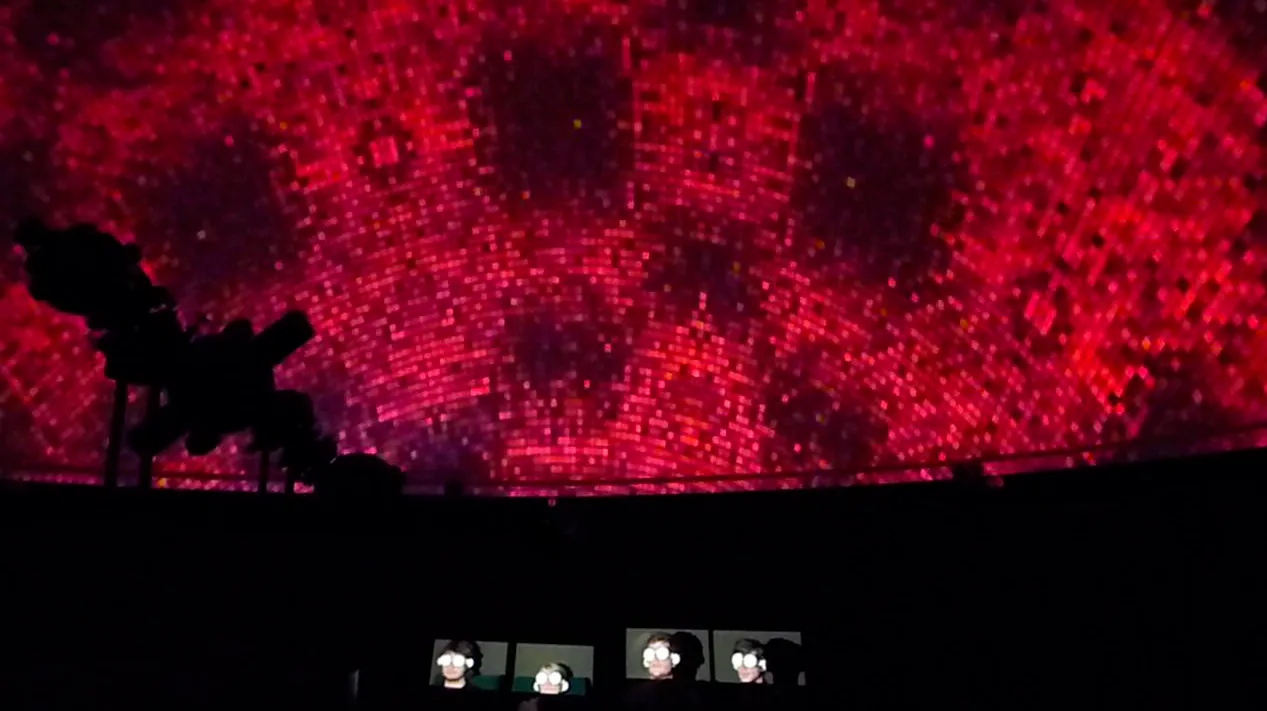
For the semester finale the experiment moved into the Powerdome, the fulldome at the Urania Planetarium in Potsdam. The setup was the same as at the Lange Nacht, this time with four volunteers instead of three. The EEG data was translated into a 4×4 matrix, color-coded by the dominant wave type — beta, alpha, or theta — and tiled across the dome ceiling. The whole room pulsed with the subject’s brain activity, which gave the projection itself a mildly hypnotic side effect.
Michael Härtel had first come across infrasound in this course; the following winter, he and I tried to picture it in Afterglow.
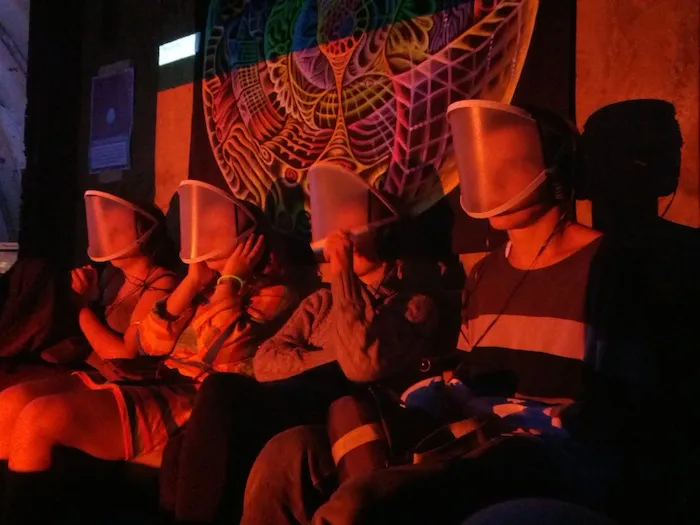
In July 2012 we brought an advanced version to the Freqs of Nature festival: a collective mind machine in an old aircraft hangar, with four seats on a cinema bench in front of the projector, each with a new visor, and a flicker projection extended with moving images and changing colors. The link to the NeuroSky headset failed on site, so the machine played back light-and-sound sequences derived from EEG recordings of a meditating subject.
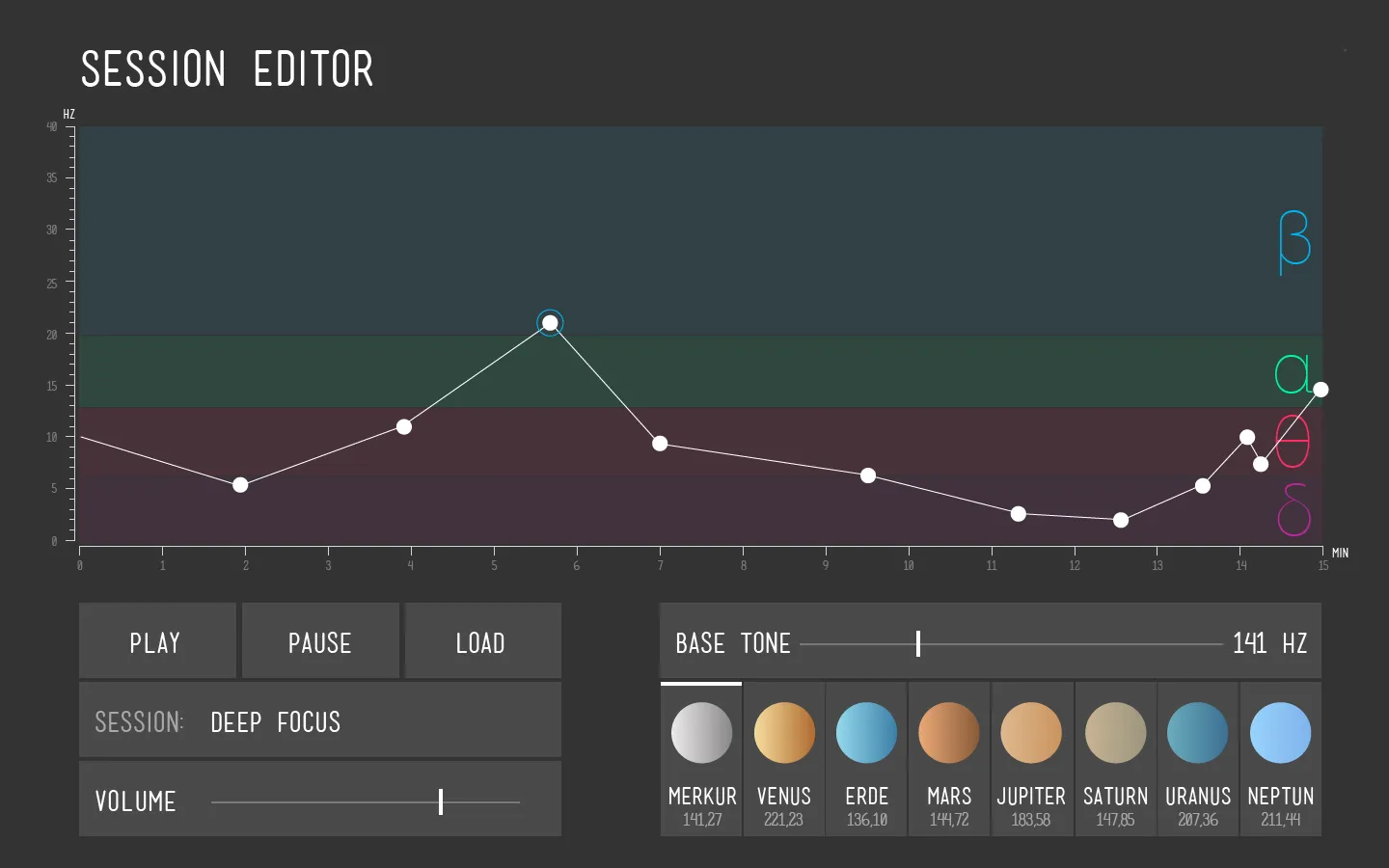
We returned to Freqs of Nature three or four times, each time with an improved or entirely different mind machine. In 2013 we traded the projector for LED visors and moved to a quieter spot with couches and blankets. An openFrameworks app ran the sessions, with an Arduino passing the rhythm on to the LEDs. After a first session of about fifteen minutes, visitors helped compose their second one in a simple session editor. People stayed 45 minutes on average, and when two of our three machines were destroyed on the first night, the sessions became one-on-one and even longer. For the Neurovillage in 2014 we developed the editor further into a web-based version that saved every session for later analysis. In 2015 it became BrainEdit, a small desktop app for composing binaural light-and-sound tracks and playing them on Arduino LED goggles.
Beyond Perception, the bachelor’s thesis Luis Grass and I wrote in 2014, became the culmination of these experiments.
The full process is documented (in German) on FHP Incom.
Photos: Luis Grass.
In memory of Michael Härtel.
Images
Lange Nacht der Wissenschaften, FU Berlin, 2011
Images: Photo: Luis Grass
Left and right arrow keys flip through the pile, Enter enlarges the top image.